

Download options
Executive Summary
On the night of July 15, 2016, Türkiye witnessed a violent and chaotic military mobilization. Tanks appeared on the streets of Istanbul. Fighter jets flew over Ankara. The parliament building and police facilities were attacked More than 250 people lost their lives.
Blame without an Investigation: Within hours, the Erdoğan government had already characterized the event as a military coup attempt and assigned blame to Fethullah Gulen and the movement he inspired.
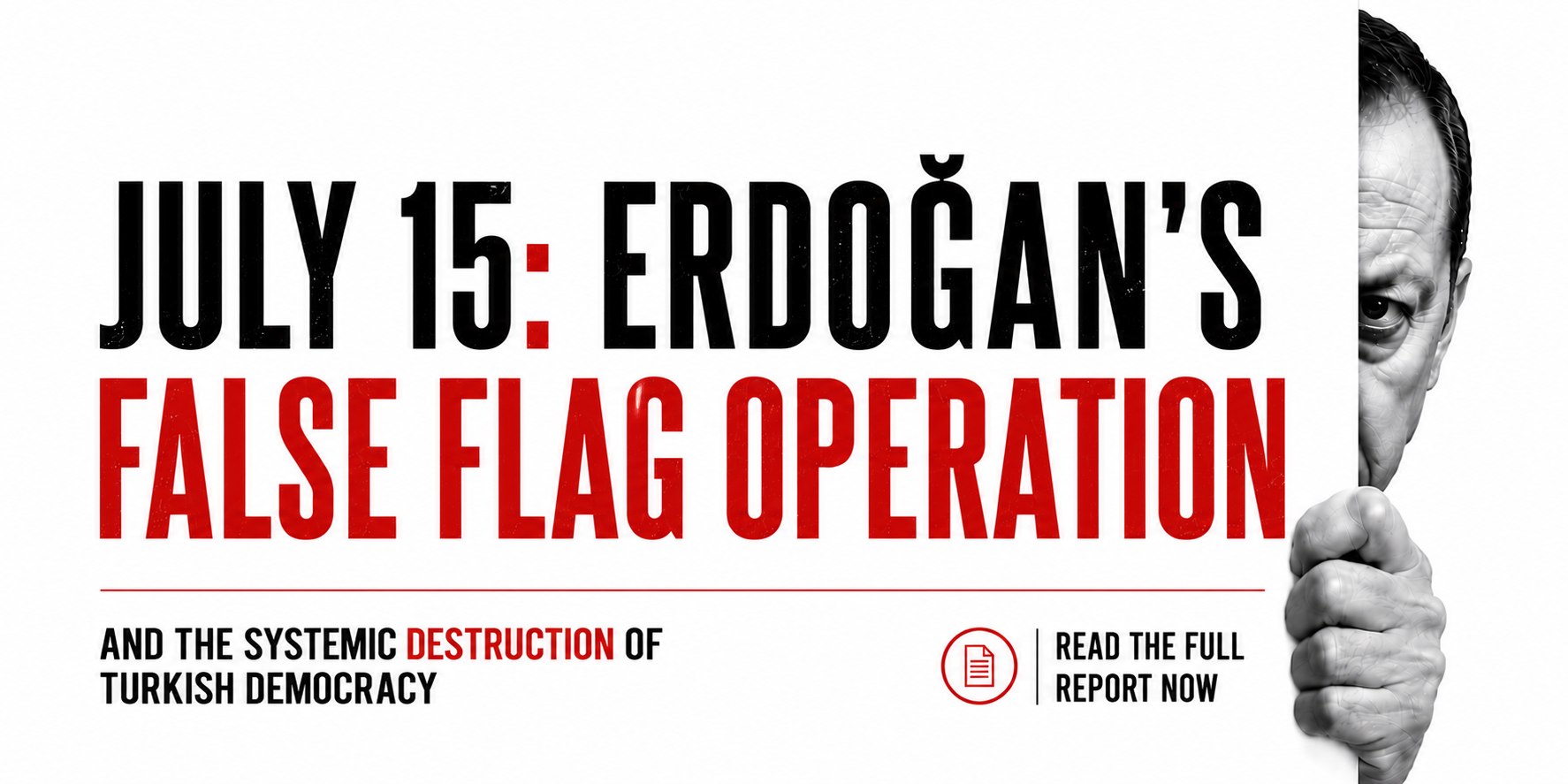
This report reaches a fundamentally different conclusion: July 15 was not a conventional coup attempt that President Recep Tayyip Erdoğan and political leadership merely survived. It was a false flag operation that created the appearance of a military coup while producing the political conditions Erdoğan needed to make a systemic change to full authoritarianism.
Misleading Orders: This report reveals a pattern where most of the soldiers mobilized that night did not understand the broader operation. The available testimonies indicate that many soldiers, military students, pilots, and officers were deployed under misleading orders, including claims that they were responding to a terrorist threat, participating in a military exercise, or protecting strategic facilities. Many of these officers and soldiers were later prosecuted for carrying out orders issued through the formal chain of command, while the commanders who gave those orders were never questioned. The main responsibility lies not with these misled soldiers but with the top-level commanders who mobilized military units and the Erdogan-centered governing structure with which they colluded.
Not a Singularity but the Next Stage in the Authoritarian Drift: July 15 did not begin Türkiye’s authoritarian transformation. Erdoğan had already spent years building the political, economic, judicial, media, and security architecture that made such an operation possible. Loyalist business networks had been enriched through public tenders, state-backed financing, public guarantees, tax advantages, and regulatory protection. Major media organizations had been transferred to government-friendly owners. The judiciary had been progressively politicized, particularly after the December 2013 corruption investigations. Security and intelligence institutions had increasingly aligned themselves with Erdoğan’s personal authority. Political opponents and independent social groups had been described as traitors, terrorists, viruses, and existential enemies.
Contradictions of the Official Narrative: The official account of the night contains major contradictions. Türkiye’s intelligence service reportedly received a warning several hours before the mobilization began, yet no nationwide alert was issued. The Director of National Intelligence neither informed or protected president Erdogan or prime minister Yildirim. Erdoğan claimed that he learned of the events from his brother-in-law rather than from the Intelligence Director or Chief of the General Staff. Although alerted several hours in advance, the Chief of General Staff neither informed nor protected the political leadership or his own office, nor did he take the necessary steps to suppress a possible mobilization.
The overwhelming majority of the armed forces neither joined the mobilization nor moved decisively to stop it. The alleged coup had no publicly identified leadership, no coherent command structure, no realistic political program, and no credible plan for taking control of the critical institutions.
The mobilization began during evening rush hour, produced highly visible scenes on the Bosphorus Bridge, mobilized military students and junior personnel, and involved actions that were operationally counterproductive for a genuine coup but politically useful for creating public fear, anger, and spectacle.
Key political leaders were not detained. Government-aligned media was not controlled and continued to broadcast. Communications infrastructure was not effectively seized.
Air Force General Akın Öztürk was claimed to be the military leader of the military mobilization, but he commanded no military units at the time. On July 21st, Chief of General Staff Akar published a message on the official website of the General Staff that confirmed that Ozturk was sent to Akinci Airbase to stop the mobilization on orders from Akar himself. This message, however, was removed shortly thereafter. Akar never answered questions about the reason for the removal of this message, which was essentially an official admission of Ozturk’s innocence. The United Nations Working Group on Arbitrary Detention later found his detention arbitrary and identified serious violations of international legal standards.
The treatment of military and police officers who protected Erdoğan also contradicts the official narrative. Pilots who reportedly escorted his aircraft and members of his security detail who defended him were later dismissed or detained over alleged links to the movement. If these individuals were part of a coordinated operation to remove Erdoğan, their conduct that night directly contradicts the government’s account of the events.
The civilian deaths require a genuine and independent investigation. The Erdoğan regime has used the victims as a rhetorical shield against scrutiny while keeping critical autopsy, ballistic, and crime-scene material outside effective public examination. Evidence cited in the report raises questions about unidentified shooters, impossible firing angles, weapons that did not match those of the accused soldiers, deleted recordings, and deaths due to causes unrelated to military gunfire.
The Purge Lists were Ready the Next Day: The developments immediately after July 15 reinforce the conclusion that the event was connected to a pre-existing political project. Within hours, thousands of judges and prosecutors were suspended or detained. Large lists of administrative purges were activated before any investigation could possibly have taken place. The numerical asymmetry is equally revealing. Only a small fraction of military personnel were convicted for direct participation in the events of July 15. Yet millions of people were subsequently investigated, hundreds of thousands were prosecuted or convicted, and more than 130,000 public servants were removed through emergency procedures. The enormous difference between the number of people mobilized during the night and the number of people subjected to punishment afterward demonstrates that investigations were not limited to coup participants. It was the political, institutional, social, and economic liquidation of a targeted community and anyone else who is perceived by Erdogan as a threat to his power.
State of Emergency to Justify the Crackdown: The state of emergency that was declared right after the incident transformed this objective into government policy. Emergency decrees replaced ordinary legislation. Judges, prosecutors, military personnel, police officers, teachers, academics, diplomats, doctors, journalists, and other public employees were removed without due process. Thousands of schools, universities, associations, foundations, dormitories, hospitals, media organizations, trade unions, and businesses were closed, confiscated, transferred, or placed under government-appointed trustees.
The principle of individual criminal responsibility was replaced by guilt by association. Previously lawful activities—including working at licensed institutions, holding an account at Bank Asya, subscribing to newspapers, joining authorized trade unions, participating in charities, attending particular schools, or using communication applications—were retroactively presented as evidence of membership in a terrorist organization.
The Purge of the Judiciary: The purge of the judiciary was central to this transformation. Thousands of judges and prosecutors were removed, while a much larger new judicial cadre loyal to Erdogan was appointed in their place. Courts continued to exist, but their institutional function changed. Rather than administering the law, the judiciary began to translate political decisions into legal outcomes. The judiciary was not merely weakened, rather it was fully transformed into a political instrument.
Systemic Human Rights Abuses: The human consequences extended far beyond prosecution and imprisonment. Allegations of torture, sexual abuse, beatings, deprivation of medical care, arbitrary disciplinary measures, solitary confinement, and degrading prison conditions became part of the post-July 15 order. At least 1,336 deaths include cases involving illness, suicide, prison conditions, dangerous escape routes, deaths in custody, and the denial of adequate healthcare.
Dismissed individuals lost salaries, professional licenses, passports, medical insurance, housing security, and access to employment. Families were stigmatized. Children carried the consequences of accusations directed against their parents. The purge created not only legal punishment but also social death.
Confiscation of Private Financial Assets: The economic dimension was equally important. Companies, schools, media organizations, foundations, hospitals, and other properties were confiscated or placed under government-appointed trustees. The estimated value of assets taken from individuals and institutions associated with the Hizmet movement is approximately $50 billion. These measures transferred their financial assets and physical properties to Erdogan’s cronies.
Justification for Systemic Change: July 15 also supplied the political conditions for constitutional transformation. The 2017 referendum was held under the state of emergency, amid severe inequality of media coverage, institutional repression, and legal harassment. The parliamentary system was replaced by an executive presidency. The office of prime minister was abolished. Presidential influence over appointments, administration, security policy, budgets, decrees, and the judiciary expanded. Temporary emergency powers became permanent presidential power.
The 2024 local elections demonstrated that the opposition could defeat Erdoğan electorally. The response was not democratic adaptation but intensified judicial intervention. The regime applied the same oppressive methods to new targets. Kurdish politicians, journalists, civil society actors, elected mayors, businesspeople, and, finally, the leadership of the main opposition CHP were subjected to politically driven prosecutions.
This continuity is essential. The post-July 15 system was never designed solely to eliminate the Hizmet movement. It was designed to eliminate dissent. Hizmet was simply the first group against which it was applied at full scale.
Once established, the method became reusable: construct a threat, criminalize a social or political group, coordinate the media narrative, mobilize the judiciary, seize institutional resources, and narrow political competition through legal force.
Transnational Repression: The repression also crossed Türkiye’s borders. Renditions, abductions, passport cancellations, INTERPOL misuse, intelligence surveillance, extradition pressure, intimidation, and the targeting of exiled journalists extended the purge abroad. Educational institutions linked to the movement were closed, confiscated, transferred, or restructured across numerous countries, often under Turkish diplomatic pressure.
Democracy watchdog Freedom House ranked Turkey in 2022 as the world’s second most frequent perpetrator of direct, physical transnational repression, targeting journalists, exiles, and dissidents. Türkiye’s own public statements reflected the scale of the campaign. According to Freedom House, the Turkish government claimed to have returned 116 people from 27 countries in connection with the Hizmet Movement.
Fethullah Gülen’s Response: Fethullah Gülen condemned the military mobilization while it was still unfolding, denied involvement, and repeatedly called for an independent international investigation. Erdoğan never responded to these calls.
A government that is confident in its account would have published the parliamentary findings, released the relevant intelligence and military records, permitted senior officials to testify, opened an independent forensic examination of the civilian deaths, and welcomed an international inquiry. The Erdoğan regime did none of the above; instead, it suppressed any efforts to illuminate the incident.
International Response: The international response further exposes the evidentiary weakness of the official narrative. German intelligence, the British Parliament’s Foreign Affairs Committee, American officials, international courts, and UN working groups did not accept the Erdogan regime’s central claims. They repeatedly distinguished between the possible conduct of individual actors and the collective criminal responsibility imposed on an entire civil society movement.
The conclusion of this report is therefore clear. July 15 was a false flag operation planned and executed by the Intelligence Operation (MIT), the Chief of General Staff and the top brass under Erdogan’s direction. July 15 was not the victory of Turkish democracy. It supplied the founding myth for its systemic destruction
The conclusion of this report is therefore clear. July 15 was a false flag operation planned and executed by the Intelligence Operation (MIT), the Chief of General Staff and the top brass under Erdogan’s direction. July 15 was not the victory of Turkish democracy. It supplied the founding myth for its systemic destruction.